



On June 9, NYU Shanghai’s inaugural forum on Knowledge Sharing and the Ideas Industry hosted pundits, academics, and leading entrepreneurs who analyzed the explosive growth of online knowledge sharing in China and its transformative relationship with the business sector.
Over the past two years, the demand for online knowledge has skyrocketed, with the Chinese market now booming in paid knowledge-sharing businesses—a result of online payments becoming the public norm. The forum, organized by the NYU Shanghai Center for Business Education and Research (CBER), staged keynotes and panel discussions that addressed the topic from perspectives of both commerce and public interest.
“In a fast-changing society marked with uncertainties and possibilities, improving our quality and competitiveness relies on the sharing of knowledge and wisdom,” said NYU Shanghai Chancellor Yu Lizhong, welcoming some 300 attendees on Saturday along with Vice Chancellor Jeffrey Lehman. They encouraged CBER to further explore emerging technologies and business models.
When it comes to knowledge dissemination and sharing, “CBER and NYU Shanghai’s mission, in general, is to open our classroom to the world,” affirmed NYU Shanghai Dean of Business Prof. Chen Yuxin, an initiator of the forum.

“Paying Around Knowledge”
Kickstarting the morning session moderated by Prof. Yan Dengfeng, NYU Vice Provost for Educational Technologies Clay Shirky pointed out that designing proper business models for online knowledge sharing requires the study of human interactions around online transactions.
“The transactions have a whole range of human interactions tied to them, which are meant to deepen relationships and make transactions feel better. It’s not paying for content. It’s paying around content,” he said, citing cases of the gaming and online literature industries.
Shirky predicted that knowledge sharing enterprises will begin offering “higher-value, higher-cost” ways of interacting with the individual knowledge sharer. “They will be down toward offering a higher degree of personalization at a higher cost, and explore new ways of accepting the human value in the process of paying for content,” he said.
Zhu Hong, professor of business at Nanjing University, discussed the productization of non-utilitarian knowledge, which she coined “impractical knowledge” and its possible business models, using her experience of founding and running the Elites Women Book Club as an example.
Writer, speech coach and columnist Ma Xujun, suggested the concept of “knowledge service” to replace “knowledge payment,” as the ability to filter and concentrate on what’s useful becomes crucial in an era of information overload. “The nature of education is to help us save time, to acquire the desired knowledge more efficiently and therefore, extend our lives,” he said.

Business Opportunities
The era of paid knowledge sharing has opened China to new opportunities, according to Xiong Mingwang. The founding partner and CEO of Shenzhen Qianhai Xingwang Investment Management Co Ltd mentioned the success of content sharing platforms Zhihu and Himalaya, both flourishing since 2016. In the afternoon session moderated by Prof. Shi Heini, he advised investors to seek opportunities in multiple links of the knowledge sharing eco-system, namely, the upper stream of content production and downstream of distribution.
Zhang Tao, Vice President of Ximalaya, introduced the company’s creative model of sharing human intelligence via podcast programs. He talked about how Himalaya’s global expansion efforts aimed to expose the US, Japan, and Germany to Chinese culture in the form of quality clips.
Concluding the forum, Liang Xiaoya, Partner and Head of Innovation and Business School Hundun University, called for a model of “automated education based on the integration of different thinking patterns, structured knowledge databases and interactive algorithms,” as a way to balance the alarming contrast between overwhelming online content and people’s limited attention spans.
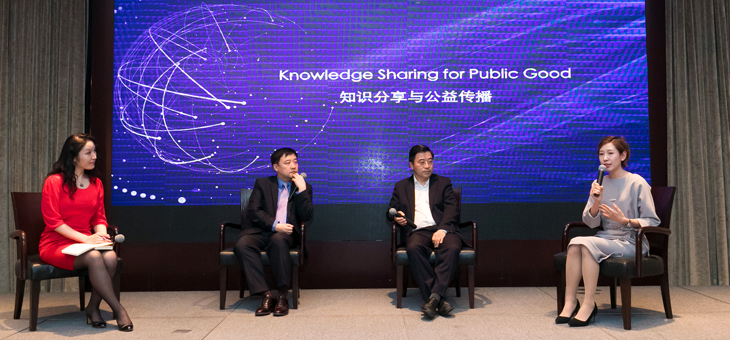
The forum also presented two panels where opinion leaders in education, media, and digital industry debated the best possible business models for knowledge sharing to maximize public benefit.
知识共享:商业机遇与公益实践
6月9日,上海纽约大学举办首届“知识共享和内容传播论坛”。本次论坛汇聚来自相关领域的著名专家学者和内容创业者,交流研讨这一新兴行业的商业模式、产业生态、消费行为和政策走向,一同把脉内容付费的发展趋势,展望行业未来。
伴随着中国消费者对线上知识学习需求的增长,以及对内容付费习惯的养成,过去两年来,中国的知识分享和内容传播产业经历了快速发展。对于这一新兴产业的探索与思考已成为教育、媒体和数字产业共同关心的热点。为进一步研究探讨这一新兴现象及相关重要议题,上海纽约大学商学教育与研究中心举办了此次论坛。
上海纽约大学校长俞立中和常务副校长雷蒙对到场的嘉宾和近三百名观众致以欢迎。俞校长表示,“我们生活在一个快速变化的社会当中,在充满不确定性的同时,也伴随着各种可能。如何去探索这些可能,发展个人能力,提升综合素养,需要知识的共享与传播。”他也鼓励上海纽约大学商学教育与研究中心继续探索新兴科技与商业模式的种种可能。
就知识传播与共享,此次论坛组委会成员之一、上海纽约大学商学部主任陈宇新表示,“上海纽约大学以及商学教育与研究中心希望能通过各种活动与机会,将我们的知识资源向全世界开放。”
知识付费
上午场论坛由上海纽约大学市场营销学访问副教授严登峰主持。讨论期间,纽约大学教育科技副教务长Clay Shirky指出,创建在线知识共享商业模型,需要对在线交易的人际互动进行深入研究。
“在线交易涉及一系列人际互动,可以加强人际关系,使交易过程更加便捷舒心。顾客付钱购买的不是内容,而是围绕着内容的附加值,”Clay Shirky说,网络游戏以及网络文学的兴起就是围绕着优化在线交易流程,使其更人性化。
他预测,未来的知识共享企业将提供更“高价值、高成本”的服务,增加消费者与知识分享人的互动交流。“这一产业将出现费用更高的个性化定制内容,并围绕内容付费设计更优化的交易模式,以凸显背后的人本价值。”
南京大学营销与电子商务系教授朱虹探讨了非实用知识的产品化,她以自己创立运营“半城读书会”为例,介绍了“无实用价值知识”的概念及其潜在的商业模式。
撰稿人、演讲教练、专栏作家马徐骏提出用“知识服务”的理念代替“知识付费”,因为在信息负荷过重的时代,筛选出有意义的信息才是最关键的。他认为,“教育的本质是教会我们如何节省时间,以及如何快速高效地掌握某项知识,从而延展我们的生命。”
商业机遇
深圳兴旺投资创始合伙人兼CEO、喜马拉雅董事熊明旺将2016年称为中国付费知识共享的元年,随着知乎和喜马拉雅等平台获得巨大成功,付费知识共享为中国带来全新机遇。在上海纽约大学管理学实践教授施黑妮主持的下半场论坛上,熊明旺建议投资者在知识共享生态系统的多个链条,包括内容创作上游与内容传播下游寻找潜在机会。
喜马拉雅副总裁张韬介绍了其公司通过播客节目分享人类智慧的创意理念与模式。在谈及喜马拉雅的全球战略时,他表示,计划通过传播中国文化的高质量音频内容打入美国、日本和德国市场。
混沌大学合伙人、创新商学院负责人梁晓雅在会议尾声的主题演讲中,呼吁实现“基于底层的思维模型、结构化知识库和交互性算法的教育自动化”,以此减轻网上海量知识信息和人们有限注意力之间的矛盾。
此外,论坛还设立两个座谈分享的环节,来自教育界、媒体和数字传播行业的意见领袖探讨了知识共享的最佳商业模式以及如何最大限度地服务公共利益。