


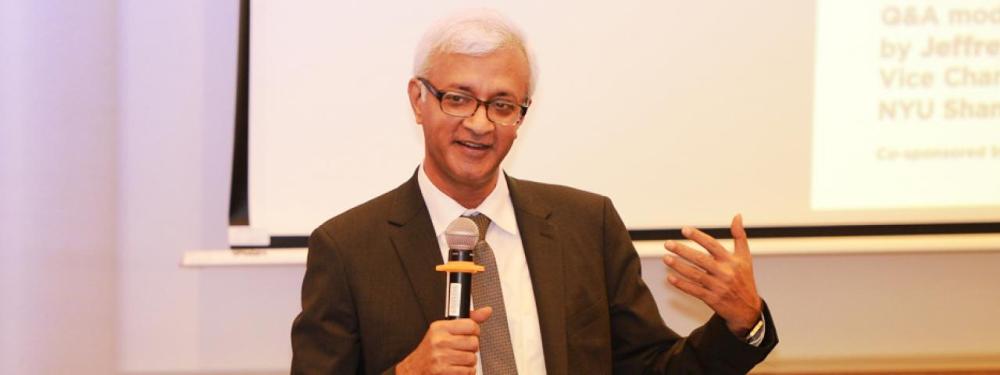
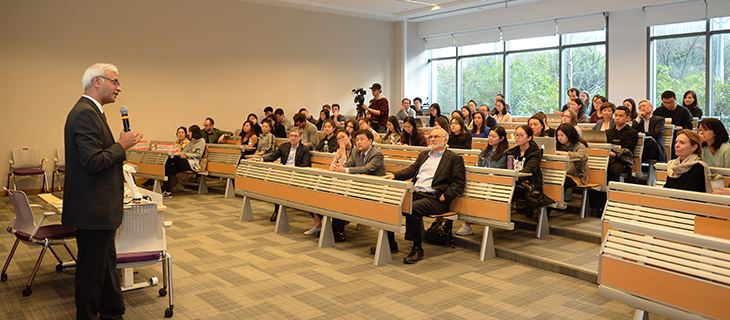
On March 12, Dean of the NYU Leonard N. Stern School of Business, Rangarajan Sundaram, shared with an NYU Shanghai audience the importance of embracing technology and innovation when it comes to developing business education.
With more than 20 years of service at NYU Stern, Sundaram assumed deanship in January 2018 after serving as vice dean of MBA programs for the past two years. During that time, he launched new, specialized one-year MBA programs in technology and entrepreneurship, and in fashion and luxury. He also garnered support from executives at leading businesses such as Amazon, Jigsaw, Microsoft, IBM, PayPal and others to join Stern’s newly created Tech MBA Advisory Board.
More than 70 percent of Stern full-time MBA students specialize in a finance area, according to Sundaram, but an increasing number of graduates from the “financial powerhouse” are pursuing jobs after their MBA in non-finance fields, such as in consulting and tech firms.
“We are expanding our core curriculum to include a wide range of technology-related courses such as machine learning and algorithm analysis,” said Sundaram. “Students are also encouraged to participate in live case studies with organizations to tackle problems that big corporations are facing today.”
For applicants interested in pursuing careers at the intersection of business and technology, Sundaram pointed to the Andre Koo Tech MBA, one of a series of Stern’s innovative, specialized, one-year programs that equips students to adapt to the new market landscape.
He also warned against the risk of solely utilizing technology in business operations, pointing out that companies today tend to rely on data analysis or artificial intelligence in their decision making process. He noted that data can be limited and biased, and therefore may jeopardize the accuracy of results.
“It means that the most important aspect of our education now is not only about how to apply technology, but also how to overcome its shortcomings,” Sundaram said, citing the example of AI Now, an interdisciplinary NYU institute that examines the social implications of artificial intelligence, including its biases.
He also mentioned that Stern is collaborating with NYU Shanghai on new innovations that will be announced in the near future.
商业与科技的跨界思考
3月12日,纽约大学斯特恩商学院院长Rangarajan Sundaram到访上海纽约大学,与师生探讨商业教育如何迎接、应对未来技术与创新的崛起。
Sundaram教授在斯特恩商学院任教20多年,在结束两年的副院长任期后,今年1月开始任院长。在任职副院长期间,他发起设立了一年制的新MBA项目,涵盖科技与创业,以及时尚与奢侈品领域,并获得亚马逊、Jigsaw、微软、IBM和PayPal等行业顶尖企业高管的支持,吸引他们加入斯特恩商学院新成立的科技MBA顾问委员会。
Sundaram教授说,超过70%的斯特恩商学院全日制MBA学生选择金融方向,但越来越多学生在MBA毕业后,从金融行业转入咨询或科技等非金融领域工作。
“我们正在扩大课程设置,纳入更为广泛的技术相关课程,例如机器学习和算法分析,”Sundaram教授说, “我们鼓励学生进行实时案例研究,解决大公司当下所面临的问题。”

对有志于在两个行业交叉地带寻求职业发展的学生,Sundaram推荐说,斯特恩商学院开设的创意专业系列之一——Andre Koo Tech MBA(辜仲立科技MBA项目)就是适应新市场变革的一个很好的选择。
他还提醒在商业运营过程中过于依赖技术所带来的风险,指出目前很多公司倾向于在决策过程中大量使用数据分析或人工智能,但这些数据可能受到限制或具有倾向性,会影响结果的准确性。
“这意味着,当下我们的教育最重要的不仅是教会学生如何应用技术,还应涉及如何克服各项技术的缺陷,” Sundaram教授以纽约大学跨学科研究所AI Now为例说。该研究所致力于探究人工智能可能造成的社会影响,包括人工智能可能带有的偏见。
Sundaram教授说,斯特恩商学院正在与上海纽约大学进行创新合作,将在不久的将来宣布最新进展。